Democrats lead Georgia's early vote by about 300,000. To tie the final count, Republicans need about 63% of Tuesday's Election Day votes, slightly more than Brian Kemp won on Election Day in 2022.
Georgia voters still held about 34,500 mail and electronic ballots as of Oct. 31. Many went out late, many went to addresses far from home, and Gwinnett's late ballots are coming back far more slowly than the rest of the state's.
Georgia accepted 307,051 ballots on Friday, the busiest day of this year’s early voting, and ended early voting 12.5% ahead of 2022’s pace. We estimate how the 5.4 million registered voters who have not voted early lean.
Democratic-primary ballots are about 25% above 2022 and Republican-primary ballots about 4% below at this point, and the voters still out show where the final days could move.
Voters still to come can change the picture. Republicans would need 57.9% to 59.7% of the remaining two-party vote to pull even in the Senate race, depending on turnout.
Georgia accepted 170,707 early ballots on Tuesday, its strongest weekday against 2022 since opening day, and is on track to pass 2022’s early-vote total on Friday.
Georgia needs 579,279 more early ballots to pass 2022’s final count of 2,534,136, and Monday alone brought 172,971, 16.0% more than the matching Monday of 2022.
The AJC/UGA poll gives Jon Ossoff 54% of the two-party Senate vote, just above our scenario if voters vote as in 2022, and finds the governor’s race close, as our scenarios do. The poll fits our scenarios but cannot show which of our assumptions are right.
Georgia accepted 28,343 early ballots on Sunday, Oct. 25, 264 below the low end of our range, all of the shortfall outside the Metro Atlanta Core. Inside the core, Democratic-primary and Black voters’ ballots grew faster than the core’s.
If early voters vote like similar voters did in 2022, Jon Ossoff would get roughly 51% to 54% of the two-party Senate vote. Much of our estimated Democratic lead among early voters rests on voters with no primary history, whom we assume lean about two to one Democratic.
Counties outside the Metro Atlanta Core grew 19.6% over 2022 on Saturday, Oct. 24, after growing 2.8% to 11.9% on the weekdays of Oct. 19 to 23, and voters 18 to 34 were 24.5% of the day’s ballots against 20.3% on the matching Saturday of 2022.
The Metro Atlanta Core counties cast 39.5% of Georgia’s early ballots from Oct. 13 to 23, up from 37.8% on the same days of 2022. Georgia’s 1,632,973 early ballots are 5.8% ahead of 2022, a record by a small margin: 19.9% of registered voters have voted early, against 19.7% at this point in 2022.
Georgia has accepted 1,467,774 early ballots through Oct. 22. A feature examines the AJC’s report on suburban and rural early voting: counting the same days of both years, Trump-won counties are 11.8% ahead of 2022, Harris-won counties 22.9% and the 53 rural counties 7.2%.
With Wednesday’s ballots, our scenarios still put Jon Ossoff at roughly 51% to 54% of the two-party vote if Georgians vote as similar voters did in 2022. Cobb’s early voters lean more Democratic than in 2022; Athens-Clarke’s, slightly less.
Cobb added more to its lead over 2022 this week than any other Georgia county, and Athens-Clarke, after adding early voting sites, now has the largest percentage gain over 2022 of any county. Georgia accepted 10.0% more ballots this week than on the same days of 2022, while Cherokee and Forsyth, which led the first week’s pace, fell behind 2022 each day.
Georgia’s early voters lean more Democratic than they did at the same point in 2022: more ballots from Democratic neighborhoods, fewer from the most Republican ones and fewer early voters with a Republican primary history.
Nine suburban Atlanta counties account for nearly all of Georgia’s early-vote gain over 2022, while Fulton and DeKalb, where turnout was already higher, are only slightly ahead. Mail ballots are coming back more slowly than in 2022 or 2024; part of that is how six counties record returns, and the rest the records cannot yet explain.
Georgia accepted 162,854 early ballots on Monday, 5.6% more than on the matching Monday in 2022, its smallest weekday gain so far. Fulton, Gwinnett and Cobb led the gain, while Cherokee and Forsyth, both more than 50% ahead of 2022 after the first week, trailed their 2022 Monday counts.
Georgia accepted 25,157 early ballots on Sunday, 34% more than on the matching Sunday in 2022. Most of the gain came from Cobb, Henry, Forsyth and Newton, which held Sunday voting a week earlier than in 2022. Hispanic and Asian voters are also far ahead of their 2022 pace.
About half of Georgia’s early voters chose a Democratic ballot in their most recent party primary, up from 44.4% at this point in 2022. In-person ballots from Black voters are up 17% from 2022, while in-person ballots from White voters are even.
Black voters have cast 16,460 more early ballots than at this point in 2022, 11,102 of them 65 and older, as Georgia’s total passes 2022’s. Fulton, DeKalb and Clayton are still behind.
With 19 days until Election Day, Georgia’s early vote is 29,963 ballots behind 2022, down from 60,938 through Wednesday, as Black voters and voters 65 and older nearly match 2022 and voters 18 to 34 pull ahead.
With 20 days until Election Day, Georgia has accepted 14.1% fewer early ballots than in 2022, which had one more day of in-person voting by that point.
Georgia enters the November election with 8.2 million registered voters and its most diverse rolls since at least 2018. Modeled on each group’s 2022 midterm turnout, with active and inactive registrants counted separately, November’s electorate would be less white and older than 2022’s.
Ten Republican-held Georgia House districts are rated competitive for November 2026. Their 2024 ballots, model probabilities, presidential movement, and resident profiles answer different questions about the same seats.
Republicans are favored to hold both chambers of the Georgia General Assembly, decisively in the Senate and clearly but not overwhelmingly in the House. Democrats are near certain to keep the 80 House seats they hold and roughly even money to gain six. The majority takes eleven.
Civic Forge Solutions is publishing ratings for all 236 seats in the Georgia General Assembly. In 81 of them only one major party filed, so they were decided in March. Across the 155 contested seats only three are genuine coin flips, and none are in the Senate. Every district gets two ratings: one for how it votes for the legislature, and one for how it votes for federal office.
Qualifying is closed. 697 candidates filed for Georgia's 2026 races. Browse every district on an interactive map, filter by party or lean, and use the wave slider to model different election scenarios.
From raw voting data to actionable insights: how we're helping campaigns and the public understand voter behavior through data analysis and real-time tracking.
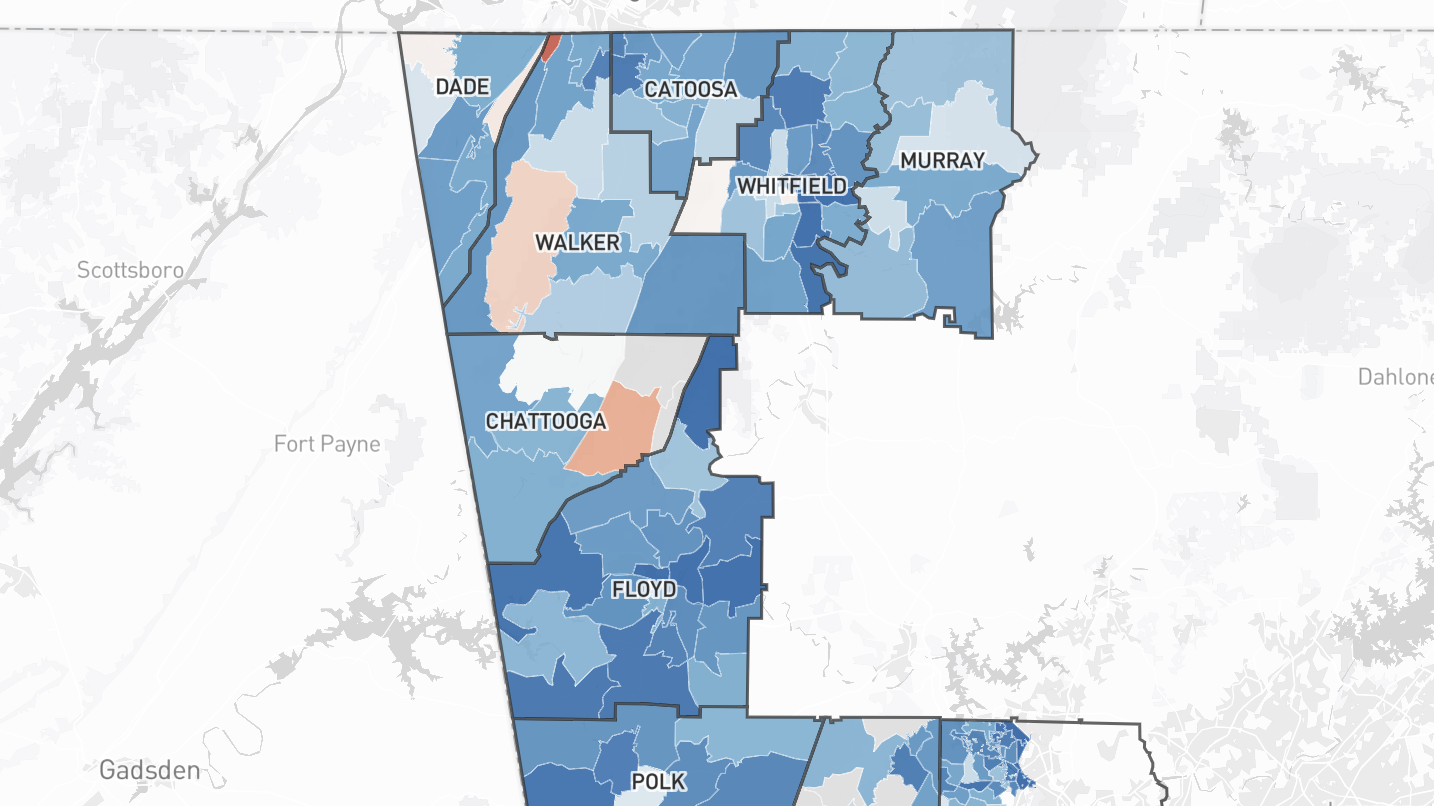
Precinct-level analysis of the GA-14 special election. Democrat Shawn Harris won a plurality with 37.3% in a 17-candidate jungle primary, triggering a runoff. The Democratic vote share rose from 35.6% to 39.8% district-wide, a uniform shift that held across all 10 counties. The runoff is scheduled on April 7th between Harris and Clay Fuller (R).
Early voting closed on March 6. 60,268 ballots were accepted in the GA-14 special election, 16.2% of the 2024 general. The last day recorded the most early votes in one day at 6,319.
With 39,749 early votes through Sunday of Week 2, the GA-14 special election has reached 10.7% of the total votes cast in the 2024 GA-14 general. Friday EV turnout rebounded to 3,560 ballots, the highest weekday total since Week 1. Five EV days remain through March 6.
With 33,027 early votes through Thursday of Week 2, the GA-14 special election has reached 8.9% of the total votes cast in the 2024 GA-14 general. Thursday posted the lowest weekday total of the early voting period at 2,155, a signal that the mid-period lull is deepening before an expected final-week surge.
With 28,132 early votes returned through Tuesday of the second week, the GA-14 special election has already surpassed 7.5% of 2024 general election turnout. Catoosa and Floyd counties are overperforming, compared to 2024. The "swing" counties of Cobb and Paulding are over and underperforming, respectively.
The GA-14 early voting electorate leans Republican by primary history, except Cobb County. However, we are seeing some interesting potential shifts within precincts with Republicans potentially losing vote share, relative to the 2024 election.
Over 20,000 ballots have been returned in the GA-14 special election through Friday. The biggest single-day turnout yet, combined with heavy activity in Cobb and Paulding, offers the first clear picture of where the electorate is engaging.
Early voting in the GA-14 Special Election continues with the lower turnout expected of a special election. While Democrats, by the numbers, face a tough contest, the final results of this contest are far from certain.
Early voting begins in the GA-14 special election with 21 candidates on the ballot. We break down the jungle primary format, Democratic upset scenarios, and the first absentee ballot data.