
Data in this article is as-of Monday, March 2nd, 2026, reflecting ballots accepted through Sunday, March 1st.
Interactive dashboard: Explore all of this data (timeline slider, daily ballot chart, partisan lean choropleth, swing simulator, and county summary table) on our GA-14 Data Dashboard.
Friday Rebound Confirms Mid-Week Lull Was Temporary
Through thirteen days of early voting, 39,749 ballots have been accepted in the GA-14 special election, or 10.7% of the 372,297 total votes cast in the 2024 GA-14 general election (all ballot types, including Election Day). Five EV days remain through Friday, March 6.
After Thursday posted the lowest weekday total of the period at 2,155, Friday’s turnout increased to 3,560 ballots, the highest single-day total since Week 1’s Friday (4,720).
The weekend numbers:
- Friday, Feb 27: 3,560 ballots (highest since Week 1)
- Saturday, Feb 28: 2,752 ballots (up from 2,175 on the first Saturday)
- Sunday, Mar 1: 410 ballots (first and only Sunday voting session)
Daily Ballot Activity
Turnout Forecast
With 13 days of data, our model projects approximately 54,000 to 58,000 total early ballots by the close of early voting on March 6. That range represents roughly 18-20% of the 292,044 early votes cast in the 2024 GA-14 general.
The final five days (Monday through Friday, March 2-6) will determine whether the district finishes at the lower or upper end of that range. In Georgia elections, the last week of early voting typically accounts for 30-40% of all early ballots. If daily totals average 3,500+ this week, the total will push toward the upper bound.
Where the Votes Are Coming From
The updated turnout composition table, comparing each county’s share of 2026 early votes to its share of 2024 general election votes:
| County | ’24 Margin | Share of ‘24 Vote | Share of ‘26 EV | Over/Under | ’26 EV Pace |
|---|---|---|---|---|---|
| Catoosa | R+45.5 | 9.2% | 12.3% | +3.0 | 14.2% |
| Chattooga | R+52.0 | 2.8% | 3.3% | +0.5 | 12.6% |
| Cobb | R+2.7 | 22.1% | 23.8% | +1.7 | 11.5% |
| Dade | R+57.1 | 2.1% | 2.4% | +0.3 | 12.0% |
| Floyd | R+32.9 | 11.7% | 13.8% | +2.1 | 12.6% |
| Murray | R+63.0 | 4.6% | 3.3% | −1.3 | 7.6% |
| Paulding | R+21.0 | 23.5% | 21.3% | −2.2 | 9.7% |
| Polk | R+54.3 | 5.0% | 5.7% | +0.7 | 12.1% |
| Walker | R+48.9 | 8.4% | 6.2% | −2.2 | 7.9% |
| Whitfield | R+32.2 | 10.4% | 7.9% | −2.6 | 8.0% |
‘26 EV Pace is 2026 early votes as a percentage of each county’s total 2024 GA-14 vote, a measure of how far along each county is relative to its 2024 baseline (not a true turnout rate). Over/Under is the gap between the county’s share of 2026 EV and its share of 2024 total vote.
Analysis
The compositional picture has been stable throughout the early voting period. The same counties that were over- and under-indexing on Day 8 and Day 10 continue the pattern:
- Catoosa (+3.0) remains the biggest over-indexer at a 14.2% EV pace, the highest of any county. This deep-red county (R+45.5) has been the standout early-voting performer throughout the period.
- Floyd (+2.1) continues to over-index, running a 12.6% pace. Combined with Catoosa, these two Republican strongholds are contributing a disproportionate share of the early vote.
- Walker (−2.2) has improved slightly from Day 10 (was −3.5) as its pace rose from 5.2% to 7.9%. It is still under-represented but closing the gap.
- Whitfield (−2.6) is now the largest under-indexer, replacing Walker. Its 8.0% pace lags the district average.
- Paulding (−2.2) continues to trail its 2024 share. As the second-largest county, Paulding’s underperformance limits the total EV count.
- Cobb (+1.7) has slightly increased its over-indexing. As the closest county to a swing county (R+2.7), its higher-than-expected share provides a small structural boost for Democrats.
Net effect: The compositional picture slightly favors Republicans compared to 2024 proportions (Catoosa and Floyd over-indexing more than Cobb), but the effect is modest and has been consistent throughout the period.
Partisan Lean of Early Voters
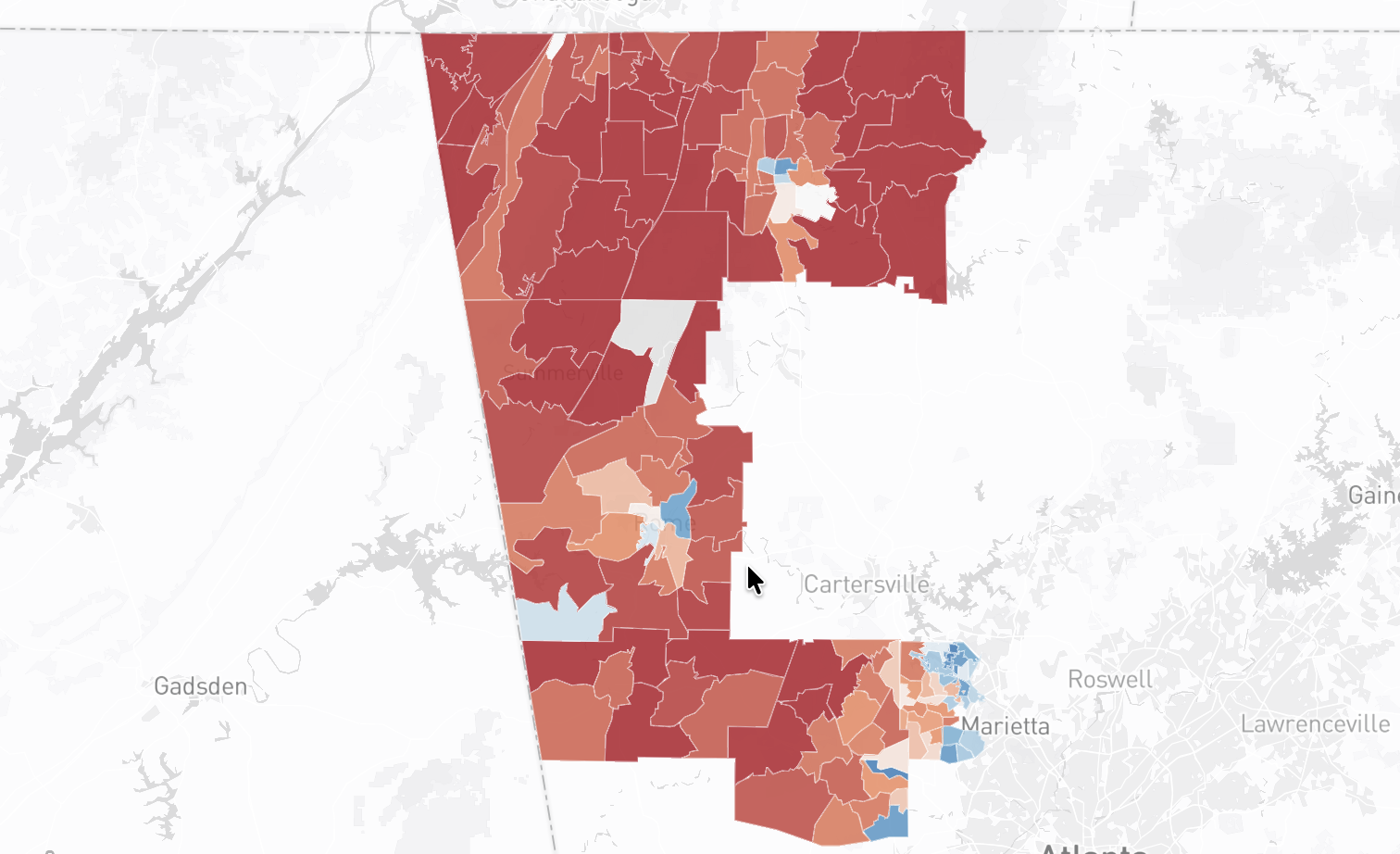
Using each voter’s last partisan primary participation as a proxy for partisan ID:
- Republican primary voters: 22,477 (56.5%)
- Democratic primary voters: 12,177 (30.6%)
- No partisan primary history: 4,561 (11.5%)
- Non-partisan: 534 (1.3%)
The partisan composition has been stable throughout the early voting period. The Republican share has held in the 56-57% range and the Democratic share has hovered around 31% since Day 8. The “no history” pool at 11.5% serves as the uncertainty band around these estimates.
Explore the geographic distribution of partisan lean across GA-14’s precincts on our interactive choropleth map:
Swing Simulator
The swing simulator applies each precinct’s 2024 congressional two-party vote shares (Greene vs Harris) to its current early vote count, producing a precinct-weighted estimated margin of R+27.7 across the district. Use the slider to model uniform swing scenarios:
- A D+5 swing brings the margin to roughly R+18, still a comfortable Republican hold
- A D+10 swing brings it to roughly R+8, competitive but still Republican
- A D+15 swing is the approximate breakeven threshold
Looking Ahead: Final Week and the Runoff
GA-14 is a deeply conservative district, and in normal times would not even be considered as a potential flip. Alas, this is not the case in March 2026. While I’m not seeing signals, thus far, in the data for a Democratic sweep, conditions are present for a weakening of Republican margins at the very least.
From a Rawstory article ($) this morning, cycle-over-cycle declines in GA-14 R+ margins, MTG’s opposition to the Trump Administration’s policies and conduct in the Iran air strikes, plus rumblings of mainstream non-MAGA Republicans gaining favor provide political plausibility to an electoral upset favoring Democrats.
Would enough self-identified Republicans in GA-14 flip their votes in this race to a Democratic candidate? Our model estimates that a 15-point partisan swing would be needed to make the race competitive in a direct runoff matchup between a Democrat and Republican.
And still, in this special election, the Democratic frontrunner, Shawn Harris, would still need to achieve one of the two top vote-getting slots to be on the runoff ballot.
Questions? Get in touch at [email protected].
Civic Forge Solutions provides civic technology and data analysis services for progressive and Democratic candidates, campaigns, and committees. Based in Atlanta, Georgia.