

Shawn Harris is the Democratic frontrunner (left), and Republican Clay Fuller (right) was endorsed by Trump.
Early voting began today in the GA-14 Special Election to fill the Congressional seat vacated by Marjorie Taylor Greene, otherwise known by her sobriquet, MTG.
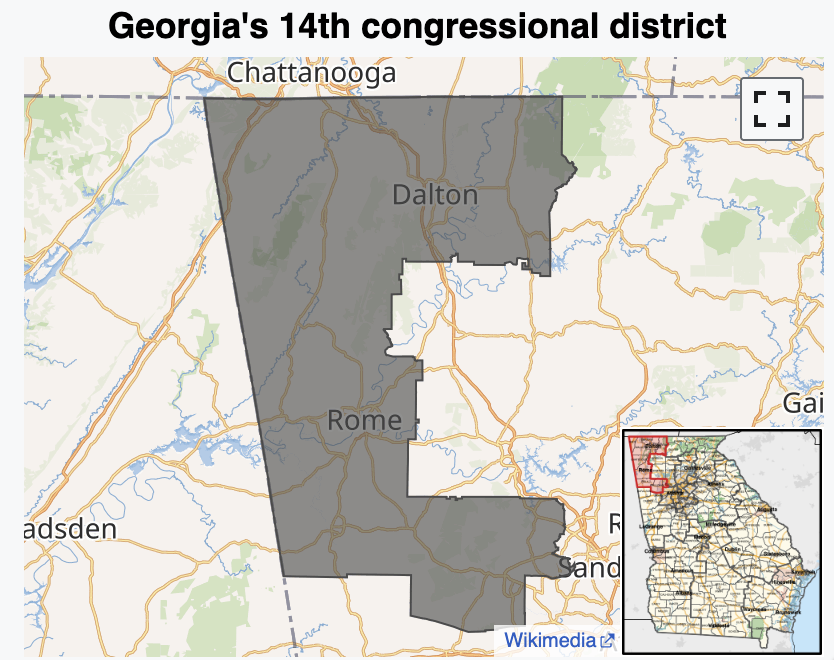
Georgia’s 14th Congressional District. Source:
Wikipedia
The Jungle Primary
In Georgia, special elections to fill vacancies are conducted as “jungle primaries.” Instead of separate party ballots, every qualifying candidate appears on a single consolidated ballot. While party affiliations are listed next to each name, the race is non-partisan in format.
To win outright, a candidate must receive a majority (50% + 1) of the vote. If no candidate reaches this threshold, the top two vote-getters—regardless of party—will advance to a runoff election. (This is, of course, not ranked choice voting.)
The winner of this special election will serve the remainder of MTG’s current term through January 2027. This race is distinct from the regularly scheduled 2026 midterm elections, which will determine who holds the seat for the subsequent full term.
21 Candidates, One Ballot
The ballot will have 16 Republicans, 3 Democrats, 1 Libertarian, and 1 independent, with more candidates on the ballot than most voters have ever seen. This fact may give Democrats an advantage. Stay with me…
Georgia’s 14th Congressional District is a Republican stronghold. In the last general election, Marjorie Taylor Greene won by 29 points, an increase from her 21-point margin in 2022. However, the unique nature of a jungle primary creates three potential “wildcard” scenarios for a Democratic victory:
- Republican votes are split so thinly among the 16 candidates that a Democrat clears the 50% threshold to win the seat outright.
- The Republican vote is so fragmented that the top two finishers are both Democrats, securing the seat for the party by default.
- If Republican voters fail to consolidate around a single candidate and Democratic turnout remains high, a Democrat could surge to a victory against a fractured opposition.
This strategy is not without merit. In December 2025, Representative Eric Gisler (D) achieved a similar upset in House District 121, capturing 50.85% of the vote. This occurred despite the district being historically Republican (+22 R in 2024).
Recent redistricting and remedial court rulings have also shifted the district’s demographics, adding Paulding County and portions of Northwest Cobb County. While these areas are still Republican-leaning, they are generally considered less “ruby red” than the district’s more exurban regions.
What’s Next
During Georgia’s early voting periods, the state releases daily totals for voter turnout (though results remain sealed until Election Day) — typically, these files are published at 4am daily.
As of today, we have information on all ballot applications prior to today, Feb 16th:
- Current Totals: As of today, 2,112 absentee ballot applications have been processed.
- Comparative Trend: At this same point during the 2024 General Election, 10,638 ballots had been sent.
- Analysis: Current requests sit at approximately 19.8% of the volume seen in the last general election—a typical trend for special elections, which often see lower but more concentrated turnout.
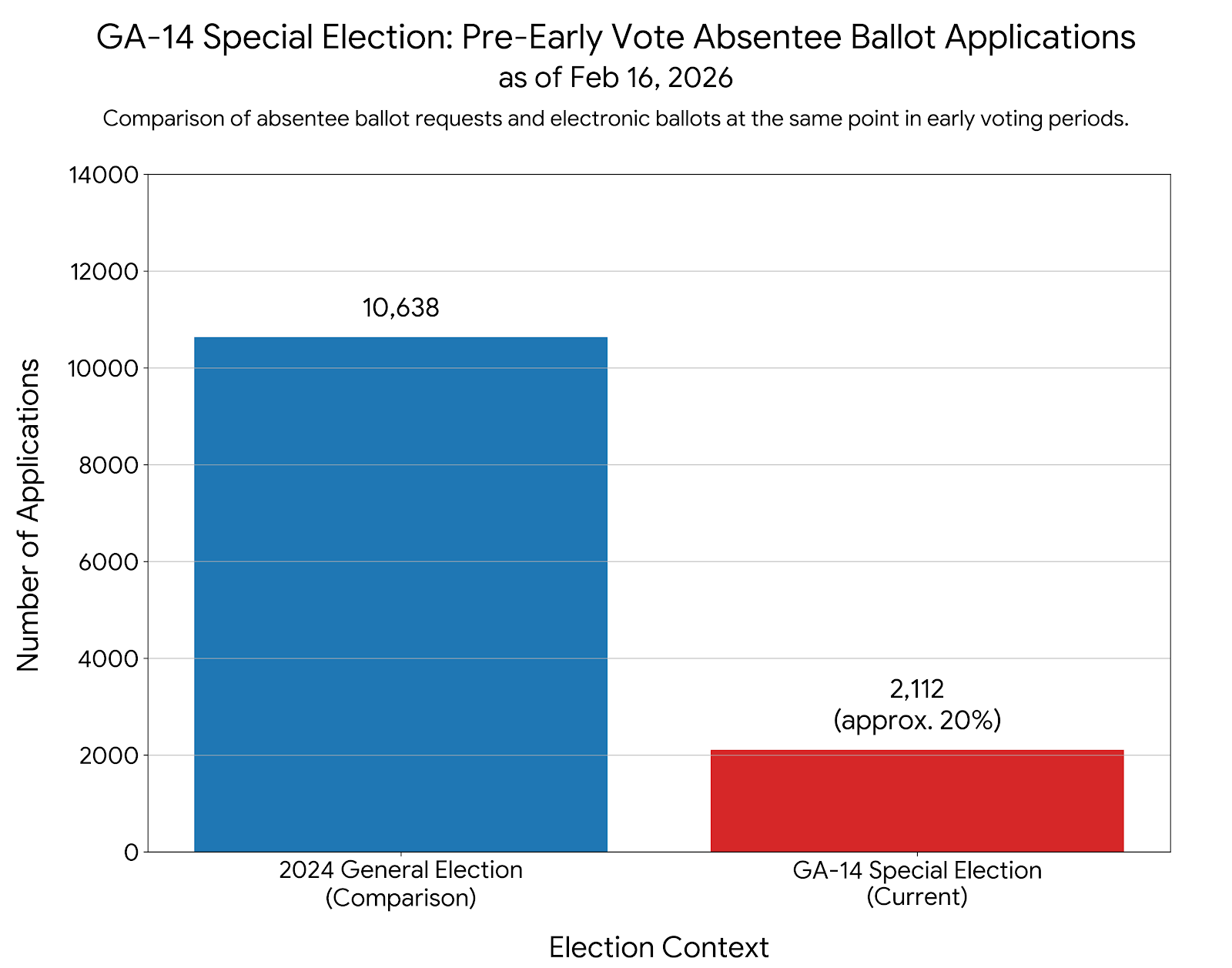
Pre-early vote absentee ballot applications comparison as of Feb 16, 2026. Source: Georgia Secretary of State.
What does this tell us? Not much other than the obvious indicator that special election turnout will likely be much lower than the general election.
Tomorrow, once we get the first set of in-person absentee ballots, we can look into locations, demographic trends, and estimated party preferences of our early voters.
Questions? Get in touch at [email protected].
Civic Forge Solutions provides civic technology and data analysis services for progressive and Democratic candidates, campaigns, and committees. Based in Atlanta, Georgia.